
Sport Petanque: Rules, History, Strategies & How to Play the Classic French Game

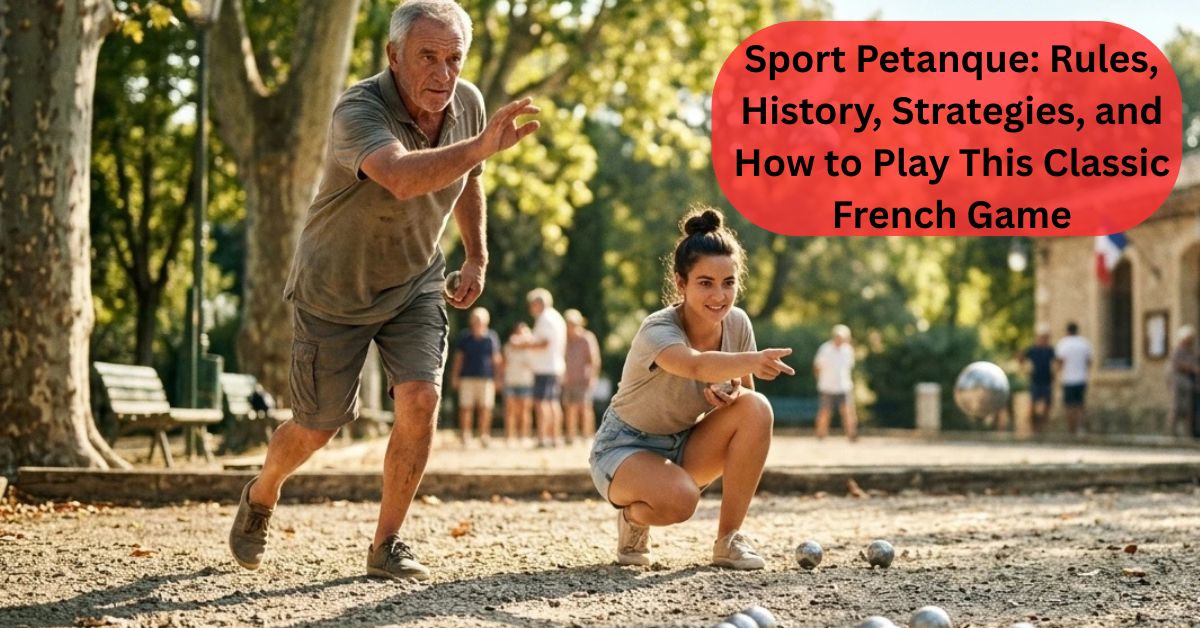
When you have been in a southern French park, and have seen contestants attentively throwing very slim metallic balls at a tiny piece of wood, you must have seen sport petanque in action. It might seem to be a simple game but the moment you play it you will instantly know that the game involves strategy, precision and patience.
My experience with petanque started with a trip to the location during summer when people came together in the evenings to play friendly games. The mood was easy and the precision and concentration of professional players were impressive. That was the point when I became interested in the sport, its rules, strategies, and competitions around the world.
I will show you all there is to know about petanque sport, I will cover rules of petanque, equipments, scoring, playing tricks of petanque and professional tournaments. No matter whether you are an inquisitive amateurs or you want to polish your expertise, this paper will make you realize why this classic game keeps gaining popularity all over the world.
What Is Sport Petanque?
Sport petanque is an accuracy ball game where participants toss hollow metal balls referred to as boules at a small wooden target called the cochonnet (also called the jack).
The goal is easy, move your boule in a closer position than your competitor.
Competitive matches involve a detailed strategy, positioning, and control unlike the idea which is straightforward to understand. International regulation of the sport is done by Federation Internationale de Petanque et Jeu Provencal (FIPJP) that regulates international competitions and uniform rules.
There are teams of play of petanque:
- singles (1 vs 1)
- doubles (2 vs 2)
- triples (3 vs 3)
Not only in France, but also in Europe, Asia and some parts of North America, the sport is popular.
Petanque History: History of the Game.
Knowledge of the petanque history contributes to the comprehension of the fact that the game still has a cultural importance.
In France an invention was made in 1910 in the coastal town known as La Ciotat, southern La Ciotat to make modern petanque. It developed out of an even older game known as jeu provencal in which the players ran up, then threw the ball.
Jules Lenoir, who was one of the founders, was afflicted with rheumatism and was unable to run before throwing. To change the game, the players were throwing off a stationary circle.
The petanque derives its name by the Provencal expression “pieds tanques” meaning, feet planted.
The sport has since been exported to other countries. It is currently played in over 160 nations and the world championships receive thousands of entrants annually.
Petanque Equipment: Equipment to Play.
It is necessary to learn how to play petanque before getting acquainted with the equipment.
Boules
Boules are empty metal balls usually of steel. They are in weight and size depending on the choice of the player and size of the hand.
Boules are usually selected by professional players according to:
- grip texture
- diameter
- weight balance
The Cochonnet (Jack)
A small wooden ball known as cochonnet is used as the target. It is found to be approximately 30 mm in diameter.
Throwing Circle
The players are in a circular ring that is drawn on the ground. During throwing both feet have to stay within the circle.
Playing Surface
Contrary to most of the sporting activities, petanque does not need a dedicated field. It can be played on:
- gravel
- sand
- compact dirt
- park paths
This availability is among the factors that have made the sport popular.
How to Play Petanque: Stepping Guide.
Playing petanque is a simple game, and therefore this makes it a good sport to start with.
Step 1: Draw the Circle
A gamer prepares a circle on the ground where the initial throw will be done.
Step 2: Throw the Cochonnet
The player who begins throws the cochonnet a distance of about 6 to 10 meters outside of the circle.
Step 3: First Boule
The first boule is thrown by the same player and he tries to hit the target.
Step 4: Opponent’s Turn
The other player has to attempt to roll a boule near the cochonnet than the nearest ball which is already in place.
Step 5: Continue Throwing
The team with the farthest boule proceeds to throw till it either gains the lead or loses all the boules.
Step 6: Round Ends
After all the boules have been thrown, the points are tallied.
Petanque Scoring System
Knowledge of the petanque scoring can be useful in explaining how a match is won.
At the end of each round:
- Only one team scores points.
- Points are the number of boules that are near to the cochonnet than those of the opponent.
For example:
When your team has three boules that are nearer to the jack one is awarded three points.
The normal game is played until one team accumulates 13 points.
This scoring system promotes careful throwing instead of aggressive throwing.
Petanque Strategies to Enhance Performance.
Although casual games are entertaining, it is necessary to learn strategies in playing the game of petanque to play competitively.
Pointing
Pointing consists of putting your boule as near as possible to the cochonnet.
Skilled players study the ground and have control over their speed and arc.
Shooting
Shooting consists of striking the opponent with his/her boule to push him/her away.
This is a technique that is practiced by professional players, as correct shots have the power to turn a round around.
Tactical Positioning
Smart teams consider:
- terrain conditions
- opponent positions
- defensive placement
The most effective plan is usually one that relies on analysis of the ground surface and modifying the plan.
Skill Levels in Petanque
Like in most other sports, the competition and tactics of sport petanque also differ with the level of skill.
Beginner Level
Beginners focus on:
- learning the movement of throwing.
- understanding basic rules
- practicing simple accuracy
At this level, consistency is a big problem among players.
Intermediate Level
The players become intermediate, and this is where strategy and precision begin to grow.
They learn to:
- control spin
- adapt to terrain
- combine pointing and shooting.
Professional Level
Players display outstanding control and mental attention in cases of professionals.
They are taking a great number of international tournaments and training to be more accurate.
Professional Petanque Tournament.
Competitive aspect of the sport is much tougher than most beginners had thought.
The Mondial la Marseillaise a Petanque is one of the most popular events which are annually organized in Marseille. It brings thousands of players in the world.
The Federation Internationale de Petanque et Jeu Provencal organizes international competitions which include:
- world championships
- continental championships
- professional invitation tournaments.
These matches are full of elite accuracy and tactical play.
How to Play Petanque: Tips on winning.
You may be a beginner and a few petanque tips on how to start playing will help to play a lot better.
Train Your Throwing Skill.
Attention should be paid to a controlled movement instead of throwing too hard.
Study the Terrain
This is the surface that influences the rolling and stopping of the boule.
Players with experience always look at the ground when throwing.
Stay Relaxed
The better you are, the more accurate you will become.
Observer Experienced Players.
Observing the proficient competitors, you come to know about positioning and strategy.
General Misunderstandings by New players.
Novices have to repeat their same errors when learning how to play petanque.
Throwing Too Fast
Accuracy is confused with power by the many new players. In practice, the controlled throws are more effective.
Ignoring Strategy
It is not just enough to be aiming at the cochonnet. It is about strategic positioning.
Standing Incorrectly
Players have to ensure that both feet remain within the circle of throwing. Unwarranted position may lower precision.
Early detection of these errors assists players in becoming better players at a quicker pace.
When not to Trust Internet Advice.
Online guides come in handy but they do not substitute professional coaching or official sources of rules.
When you intend to compete in earnest, it will be well to:
- surveys official regulations of Federation Internationale de Petanque et Jeu Provencal
- research tournament gameplay video.
- visit professional coaches or clubs in the area.
Authority institutions constantly revise regulations and competition norms, which can vary with unofficial online counseling.
Future Prospect of Sport Petanque.
Sport petanque has a promising future.
Growth is being boosted by a number of factors:
- greater foreign involvement.
- increasing popularity of elite sports.
- amateur world leagues and tournaments.
Other sports commentators even talk about how petanque can receive wider acceptance in world sporting events.
With the increasing number of new clubs and community leagues, the sport is growing further outside its European origin.
Sources and References
The sources of information used in this article include:
Official regulations of Federation Internationale de Petanque et Jeu Provencal.
- historical documentation of France sporting archives.
- tournament data of Mondial la Marseillaise a Petanque.
- international petanque federation books and bookshelf.
These references offer credible information on the regulations, history and the sport profession.
Final Thoughts
Sport petanque does not look complicated at the outset, but by learning how to play, learn the rules of petanque, the scoring system, equipment, and strategies, one learns that petanque is a game that involves precision, strategy, and patience. Since its early days in La Ciotat, France, to International competitions held by the Federation Internationale de Petanque et Jeu Provencal, it has been able to become a respected sport in the world. Its simplicity (i.e. all one needs is the basic petanque equipment and a small playing field) makes it simple to learn how to play petanque, whereas the experienced ones perfect their high-level petanque tactics. At the casual park games or the professional tournaments, after knowing the history of the sport, its methods, and its practical tips on petanque presented to beginners, you can definitely get to know why this traditional French game is still playing in the mind of players in different parts of the world.
Read more: our detailed guide on squash sport